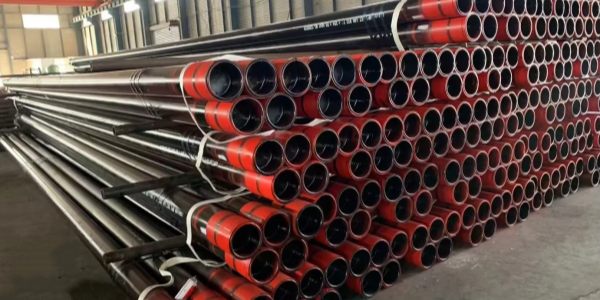
API 5CT casing and tubing pipes are critical materials in oil and gas drilling operations. They are designed for harsh downhole environments involving high pressure, corrosive fluids, high temperatures, and complex geological conditions.
As global oil and gas exploration moves toward deeper wells, shale formations, offshore drilling, and sour service environments, API 5CT OCTG (Oil Country Tubular Goods) products have become essential for maintaining well integrity, operational safety, and long-term production efficiency.
What Is API 5CT Pipe?
API 5CT is an international standard developed by the American Petroleum Institute (API) for casing and tubing used in oil and gas wells.
API 5CT Pipe Specifications
|
Item
|
Specification
|
|
Production Standard
|
API 5CT
|
|
Manufacturing Process
|
ERW / SMLS
|
|
Casing Pipe OD
|
114.3–508 mm
|
|
Tubing Pipe OD
|
26.67–114.3 mm
|
|
Wall Thickness
|
5.21–22.22 mm
|
|
Casing Pipe Length
|
4.88–14.63 m
|
|
Tubing Pipe Length
|
6.10–12.80 m
|
|
End Type
|
Plain End, LTC, STC, BTC, Extreme-Line
|
|
Joint Type
|
Threaded & Coupled, Integral Joint
|
|
Further Processing
|
Threading
|
|
Corrosion Protection
|
Lacquer, Varnish, Oiling, Galvanizing, FBE, 2LPE, 3LPE, 2LPP, 3LPP
|
API 5CT Steel Grades
API 5CT includes multiple steel grades for different well conditions.
Common API 5CT Grades
|
Grade
|
Main Characteristics
|
Typical Application
|
|
H40
|
Basic strength grade
|
Shallow wells
|
|
J55
|
Common standard grade
|
Conventional oil wells
|
|
K55
|
Similar to J55 with tighter control
|
Medium-depth wells
|
|
N80
|
Higher strength
|
High-pressure wells
|
|
N80Q
|
Quenched and tempered
|
Improved toughness
|
|
L80
|
Corrosion resistant
|
Sour service wells
|
|
C90
|
High strength
|
Corrosive environments
|
|
T95
|
Sulfide stress cracking resistance
|
Sour gas wells
|
|
P110
|
High yield strength
|
Deep wells
|
|
C110
|
Ultra-high strength
|
Extreme drilling
|
|
Q125
|
Highest strength grade
|
HPHT wells
|
API 5CT Chemical Composition Table
The following table summarizes key chemical composition requirements shown in the specification.
Chemical Requirements of API 5CT (%)
|
Grade
|
Type
|
C Max
|
Mn Max
|
Mo
|
Cr
|
Ni Max
|
Cu Max
|
P Max
|
S Max
|
|
C90
|
Type 1
|
0.35
|
1.20
|
0.25–0.85
|
—
|
1.50
|
0.99
|
0.020
|
0.030
|
|
T95
|
Type 1
|
0.35
|
1.20
|
0.25–0.85
|
0.40–1.50
|
0.99
|
—
|
0.020
|
0.030
|
|
C110
|
—
|
0.35
|
1.20
|
0.25–1.00
|
0.40–1.50
|
0.99
|
—
|
0.020
|
0.030
|
|
P110
|
EW
|
—
|
—
|
—
|
—
|
—
|
—
|
0.030
|
0.030
|
|
Q125
|
Type 1
|
0.35
|
1.35
|
—–0.85
|
—
|
1.50
|
0.99
|
0.020
|
0.010
|
API 5CT Mechanical Properties
Mechanical performance is one of the most important factors in OCTG selection.
Mechanical Property Table
|
Grade
|
Yield Strength (MPa)
|
Tensile Strength (MPa)
|
Hardness Control
|
Main Feature
|
|
J55
|
379–552
|
≥517
|
Controlled
|
General well service
|
|
K55
|
379–552
|
≥655
|
Controlled
|
Improved toughness
|
|
N80
|
552–758
|
≥689
|
Controlled
|
High strength
|
|
L80
|
552–655
|
≥655
|
Max 23 HRC
|
Corrosion resistance
|
|
C90
|
621–724
|
≥689
|
Strict control
|
Sour service
|
|
T95
|
655–758
|
≥724
|
SSC resistant
|
Acid gas wells
|
|
P110
|
758–965
|
≥862
|
Controlled
|
Deep wells
|
|
Q125
|
862–1034
|
≥931
|
Strict control
|
HPHT wells
|
API 5CT Casing Dimension Table
API 5CT Casing Pipe Thickness Table
|
OD (inch)
|
OD (mm)
|
Wall Thickness (mm)
|
|
4-1/2
|
114.3
|
5.21 / 5.69 / 6.35 / 7.37 / 8.56
|
|
5
|
127.0
|
5.59 / 6.43 / 7.52 / 9.19 / 11.10 / 12.14 / 12.70
|
|
5-1/2
|
139.7
|
6.20 / 6.98 / 7.72 / 9.17 / 10.54 / 12.70 / 14.27 / 15.88 / 17.45 / 19.05 / 20.62 / 22.22
|
|
6-5/8
|
168.3
|
7.32 / 8.94 / 10.59 / 12.06
|
API 5CT Thread Types
API 5CT pipes are available with different thread connections:
|
Thread Type
|
Full Name
|
Features
|
|
STC
|
Short Thread Coupling
|
Standard casing connection
|
|
LTC
|
Long Thread Coupling
|
Better sealing performance
|
|
BTC
|
Buttress Thread Coupling
|
High load capacity
|
|
Premium Connection
|
Proprietary Thread
|
Gas-tight sealing
|
Premium connections are widely used in:
Deep wells
Offshore drilling
Horizontal wells
HPHT projects
Corrosion Protection for API 5CT Pipe
API 5CT pipes may use multiple anti-corrosion coatings:
Black painting
Varnish coating
Oiling
Galvanizing
FBE coating
2LPE / 3LPE coating
2LPP / 3LPP coating
These coatings help improve:
Corrosion resistance
Storage life
Transportation protection
Offshore durability
API 5CT Production Tolerances
Standard Mass Tolerances
|
Item
|
Tolerance
|
|
Single Length
|
+6.5% / -3.5%
|
|
Carload≥18,144 kg
|
-1.75%
|
|
Carload<18,144 kg
|
-3.50%
|
Outside Diameter Tolerance
|
OD Range
|
Tolerance
|
|
<4-1/2 inch
|
+0.79 mm
|
|
≥4-1/2 inch
|
+1% / -0.5% D
|
How to Select API 5CT Pipe
Consider Well Environment
Evaluate:
H₂S content
CO₂concentration
Downhole pressure
Operating temperature
Choose Proper Steel Grade
J55/K55 for conventional wells
N80/L80 for deeper wells
P110/Q125 for HPHT wells
Select Correct Thread Connection
Premium connections are preferred for gas-tight and high-pressure applications.
Verify Manufacturing Standard
Ensure compliance with:
API 5CT
API Q1
ISO standards
Project specifications
FAQ
1.What is API 5CT pipe?
API 5CT pipe is casing and tubing used in oil and gas drilling operations.
2.What is the difference between casing and tubing?
Casing supports the well structure, while tubing transports oil and gas to the surface.
3.What is OCTG?
OCTG stands for Oil Country Tubular Goods, including casing, tubing, and drill pipe.
4.Which API 5CT grade is used for deep wells?
P110 and Q125 are commonly used for deep and high-pressure wells.
5.What are common API 5CT thread types?
STC, LTC, BTC, and premium connections are commonly used.

 English
 Español


 Tel : +86-18565811709
 Email :
 News
News