For SSAW (Spiral Submerged Arc Welded), ERW (Electric Resistance Welded), and LSAW (Longitudinal Submerged Arc Welded) pipes, procurement decisions should not be based solely on price per ton.
The correct evaluation model is:
Initial Cost + Installation Cost + Inspection Cost + Risk Cost = Total Cost of Ownership (TCO)
This structured guide analyzes cost hierarchy and application-driven TCO optimization under standards such as API 5L.
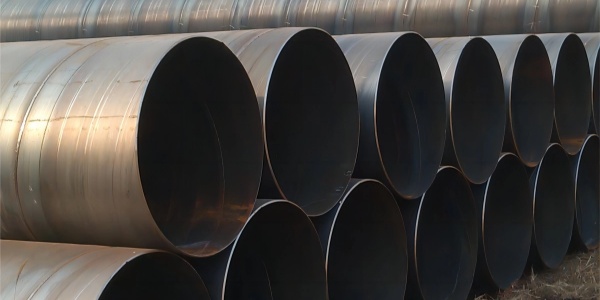
Part I – Initial Purchase Price Comparison (Baseline CAPEX)
Under similar grade and diameter (e.g., API 5L Grade B / X42):
ERW < SSAW < LSAW
1. ERW – Lowest Initial Cost
Cost Logic
Raw material: hot-rolled steel coils
Continuous high-speed production
Highly automated
Minimal forming complexity
Best cost performance: Small to medium diameters (distribution pipelines)
2. SSAW – Competitive for Large Diameters
Cost Logic
Raw material: steel coils (cheaper than plate)
Flexible diameter forming
Excellent material utilization
Large production capacity
Best cost performance: Large-diameter water & utility pipelines
3.LSAW – Highest Initial Cost
Cost Logic
Raw material: individual steel plates
UOE / JCOE batch forming
High equipment investment
Tight dimensional tolerances
Thick-wall capability
Best cost performance: High-pressure trunk pipelines
Wall Thickness Effect on Price Gap
As wall thickness increases:
Raw material cost rises linearly
Forming complexity increases
NDT cost increases
Manufacturing rejection risk rises
LSAW’s thick-wall capability expands its price gap but becomes mandatory for high-pressure design margins.
Part II – Total Cost of Ownership (TCO) Drivers
TCO is determined during installation and operation, not at purchase.
Key Variables:
Weld length & integrity
Dimensional accuracy (ovality, straightness)
NDT complexity (UT, RT, hydrotest)
Field welding efficiency
Failure risk exposure
Higher weld length (SSAW spiral seam) = higher cumulative inspection workload.
Higher dimensional accuracy (LSAW) = lower field fit-up cost.
Part III – TCO Analysis by Application Scenario
The optimal pipe is the one that minimizes TCO for a specific risk profile.
3.1 High-Pressure, High-Risk Trunk Lines
Pipe of Choice: LSAW
TCO Justification
Mandatory compliance with API 5L PSL2
Higher fracture toughness requirements
Strict impact testing & chemical control
Superior wall thickness tolerance
Lower field rejection rates
Risk Economics Principle:
The financial impact of a catastrophic pipeline failure far exceeds material cost savings from lower-grade alternatives.
LSAW reduces:
Field welding correction time
Repair frequency
Long-term failure probability
For trunk oil & gas lines, LSAW delivers lowest risk-adjusted TCO.
3.2 Large-Diameter, Low-to-Medium Pressure Water / Utility Lines
Pipe of Choice: SSAW
TCO Justification
Best diameter-to-cost ratio
Lower initial CAPEX
High production scalability
Suitable for non-PSL2 mandatory projects
While SSAW requires:
Strict weld inspection
Controlled ovality tolerance
Enhanced QA/QC management
Its lower material cost dominates total economics in large-volume municipal projects.
Conclusion: For cost-sensitive infrastructure, SSAW achieves lowest TCO.
3.3 Medium-Bore, Low-to-Medium Pressure Distribution Lines
Pipe of Choice: ERW
TCO Justification
Highest production efficiency
Excellent dimensional consistency
Smooth longitudinal weld
Lower NDT complexity vs SSAW
Fast installation
ERW minimizes:
Material cost
Installation labor
Inspection overhead
For regional gas and water distribution systems, ERW provides consistently low lifecycle cost.
Comparative TCO Matrix
|
Application
|
Pressure Level
|
Risk Level
|
Optimal Pipe
|
TCO Logic
|
|
Trunk Oil & Gas
|
High
|
High
|
LSAW
|
Risk mitigation dominates
|
|
Municipal Water
|
Low–Medium
|
Moderate
|
SSAW
|
Diameter cost advantage
|
|
Urban Distribution
|
Low–Medium
|
Low
|
ERW
|
Installation efficiency
|
Strategic Procurement Conclusion
Effective pipe sourcing requires shifting focus from:
❌ “Price per ton”
to
✅ “Risk-adjusted lifecycle economics”
ERW → Lowest baseline cost
SSAW → Best large-diameter value
LSAW → Mandatory for high-safety, high-pressure pipelines
Project success depends on integrating:
Quality assurance cost
Installation efficiency
Inspection intensity
Operational lifespan
Failure risk exposure
The optimal pipe selection is the one that delivers minimum Total Cost of Ownership (TCO) under the project’s specific pressure class and risk tolerance.
FAQ
1. What is the cost difference between SSAW, ERW, and LSAW pipes?
Under similar steel grade and specification (e.g., API 5L Grade B/X42), the typical price hierarchy is:
ERW < SSAW < LSAW
ERW: Lowest initial cost due to coil-based, high-speed continuous production.
SSAW: Mid-range cost, highly competitive in large diameters.
LSAW: Highest cost due to plate material and complex UOE/JCOE forming.
2. Why is LSAW pipe more expensive than SSAW and ERW?
LSAW uses individual steel plates instead of coils and adopts UOE/JCOE batch forming processes.
Cost drivers include:
Higher raw material price (plate vs coil)
Slower production speed
Higher capital equipment investment
Thicker wall capability
Stricter dimensional tolerance
LSAW is typically required for high-pressure applications compliant with API 5L PSL2.
3. Which pipe type has the lowest Total Cost of Ownership (TCO)?
The lowest TCO depends on application:
High-pressure trunk pipelines → LSAW
Large-diameter water pipelines → SSAW
Medium-bore distribution lines → ERW
TCO includes:
Material cost
Installation efficiency
NDT inspection cost
Operational risk exposure
Failure consequences
The pipe with the lowest purchase price does not always deliver the lowest lifecycle cost.
4. How does wall thickness affect pipe price?
As wall thickness increases:
Raw material cost rises linearly
Forming complexity increases
Inspection cost increases
Rejection risk increases

 English
 Español


 Tel : +86-18565811709
 Email :
 News
News