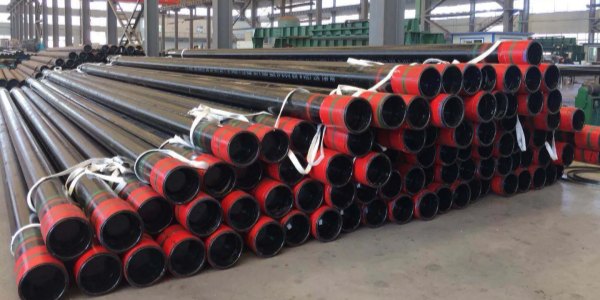
API casing tables are essential references for steel pipe manufacturers, engineers, and procurement teams in the oil and gas industry. They organize key specifications such as outside diameter (OD), wall thickness, nominal weight, steel grade, and thread connection. The most common types include casing dimension tables, weight charts, steel grade tables, connection tables, and mechanical performance tables. Understanding these references helps manufacturers verify specifications, plan production, and meet project requirements.
What Is an API Casing Table?
An API casing table is a technical reference for identifying and comparing oil well casing specifications. API Specification 5CT covers casing and tubing products, including dimensions, mass, material grades, and end-finish requirements.
Manufacturers use these tables for material selection, production planning, dimensional inspection, and order verification. However, reference charts should always be checked against the applicable API standard and project specifications.
What Are the Common Types of API Casing Tables?
1. API Casing Dimension Table
An API casing dimension table lists the main geometric specifications of casing pipe, including:
Outside diameter (OD): The external diameter of the casing.
Wall thickness: The nominal thickness of the pipe wall.
Inside diameter (ID): The internal diameter derived from the nominal dimensions.
Drift diameter: The specified clearance diameter used to verify internal passage.
End finish: The required plain-end or threaded-and-coupled configuration.
These dimensions help manufacturers confirm product configurations and ensure compatibility with well design requirements.
2. API Casing Weight Chart
An API casing weight chart specifies the nominal mass per unit length, commonly expressed in pounds per foot (lb/ft) or kilograms per meter (kg/m).
Casing pipes with the same outside diameter can have different nominal weights because their wall thicknesses differ. Weight charts are useful for estimating material quantities, transportation loads, and handling requirements.
|
Parameter
|
Description
|
Manufacturing or Procurement Purpose
|
|
Outside diameter
|
External pipe dimension
|
Confirms size compatibility
|
|
Nominal weight
|
Mass per unit length
|
Supports material and logistics calculations
|
|
Wall thickness
|
Nominal pipe-wall thickness
|
Helps verify the required casing specification
|
|
Drift diameter
|
Specified internal clearance
|
Checks passage requirements
|
Actual delivered mass may vary within the applicable tolerances and depending on the specified product configuration.
3. API Casing Steel Grade Table
An API casing steel grade table identifies material grades and their associated mechanical requirements. Common API 5CT grades include J55, K55, N80, L80, P110, and Q125.
|
Steel Grade
|
General Selection Consideration
|
|
J55
|
General casing applications requiring the specified strength level
|
|
K55
|
Applications requiring K55 mechanical properties
|
|
N80
|
Well designs requiring higher specified strength than J55/K55
|
|
L80
|
Applications requiring specified mechanical properties and, where applicable, controlled hardness
|
|
P110
|
Applications requiring high-strength casing
|
|
Q125
|
Well designs requiring a higher specified strength level
|
This table is a general reference, not a substitute for the complete standard. Grade selection should account for yield strength, tensile strength, heat treatment, hardness, and service conditions. Sour-service applications require particular attention to applicable material and environmental requirements.
4. API Casing Thread and Connection Table
Connection tables identify the thread types and end configurations used to join casing sections. Common API casing connections include:
STC (Short Round Thread): A short round-thread connection.
LTC (Long Round Thread): A long round-thread connection.
BTC (Buttress Thread): A buttress-thread connection used for specified casing applications.
Premium connections: Specialized designs for particular sealing or load-performance requirements.
Connection selection affects make-up, joint performance, and installation. API 5CT covers relevant casing product requirements, while API 5B addresses applicable threading, gauging, and thread inspection. Premium connections may require additional manufacturer specifications and qualification data.
5. API Casing Mechanical Performance Table
Mechanical performance tables help engineers evaluate whether a casing configuration meets well-design requirements. Depending on the reference, they may include material strength and calculated or specified burst, collapse, and axial performance values.
|
Parameter
|
Engineering Purpose
|
|
Yield strength
|
Evaluates resistance to permanent deformation
|
|
Tensile strength
|
Describes resistance to tensile failure
|
|
Burst resistance
|
Evaluates resistance to internal pressure
|
|
Collapse resistance
|
Evaluates resistance to external pressure
|
|
Axial capacity
|
Supports assessment of loads along the pipe axis
|
Burst, collapse, and axial capacities depend on pipe dimensions, material properties, calculation methods, and design assumptions. They should not be treated as universal values based on steel grade alone.
How Are API Casing Tables Used in Manufacturing?
API casing tables support several key manufacturing and quality-control stages:
Specification review: Manufacturers confirm the required diameter, wall thickness, nominal weight, grade, connection, and applicable standard.
Production planning: The confirmed specifications guide material selection, pipe processing, heat treatment where required, and threading operations.
Dimensional inspection: Measurements are checked against applicable tolerances. Thread gauging and drift testing are performed when required.
Testing and documentation: Required inspections, mechanical tests, product markings, and material documentation are verified against the standard and purchase order.
At Union Steel Industry, clearly defined casing specifications help align product selection with customer requirements for dimensions, grades, connections, inspection, and documentation.
How to Choose the Right API Casing Table
Before using an API casing chart for manufacturing or purchasing, confirm these details:
Applicable standard: Verify the required API 5CT edition and addenda.
Casing dimensions: Specify the outside diameter and wall thickness.
Nominal weight: Confirm the required linear mass and corresponding dimensions.
Steel grade: Check the required mechanical and material properties.
Connection type: Specify the thread, coupling, and end finish.
Inspection requirements: Define the necessary tests, certificates, and traceability.
Using the correct tables helps reduce specification mismatches, but final acceptance must follow the governing standard and project requirements.
Conclusion
The common types of API casing tables include dimension tables, weight charts, steel grade tables, connection tables, and mechanical performance references. Each serves a specific purpose, from confirming pipe geometry to selecting materials and evaluating performance. Manufacturers and buyers should use these tables together with the applicable API standards and project specifications to ensure accurate product selection and reliable quality control.
FAQ
1. What is the main purpose of an API casing table?
It helps identify casing dimensions, nominal weight, steel grade, connections, and other product specifications.
2. Which API standard covers casing pipe?
API Specification 5CT covers casing and tubing products used in oil and gas wells.
3. What information is included in an API casing size chart?
It commonly includes outside diameter, wall thickness, nominal weight, inside diameter, drift diameter, and related specifications.
4. What are the common API casing steel grades?
Common grades include J55, K55, N80, L80, P110, and Q125.
5. Are casing weight and pressure ratings the same?
No. Nominal weight measures mass per unit length, while pressure performance depends on dimensions, material properties, and design conditions.

 English
 Español


 Tel : +86-18565811709
 Email :
 News
News