ERW (Electric Resistance Welded) square tubes are widely used in modern construction and industrial manufacturing due to their uniform shape, cost efficiency, and reliable mechanical performance. Produced by forming steel strip into a square section and welding the seam longitudinally, these tubes offer excellent dimensional accuracy and surface quality.
This article provides a structured overview of the common applications, advantages, and selection guidance for ERW square tubes.
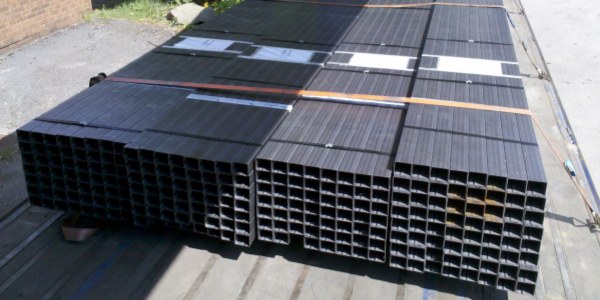
Quick Overview
Product Type: ERW square steel tube
Manufacturing Process: Electric Resistance Welding (ERW)
Common Materials: Carbon steel (Q195, Q235, ASTM A500)
Key Advantages: Cost-effective, precise dimensions, smooth surface
Main Uses: Construction, machinery, furniture, infrastructure
1. Structural Construction Applications
ERW square tubes are extensively used in the construction industry for load-bearing and structural purposes.
Typical Uses:
Steel frameworks for buildings
Columns and beams for light structures
Scaffolding systems
Roof trusses and supports
Why They Are Used:
High strength-to-weight ratio
Easy fabrication (cutting, welding, drilling)
Consistent cross-section for structural stability
2. Mechanical and Manufacturing Uses
In industrial manufacturing, ERW square tubes serve as key components in machinery and equipment.
Typical Uses:
Machine frames and supports
Equipment housing structures
Conveyor systems
Agricultural machinery
Key Benefits:
Good weldability
Uniform thickness for precision assembly
Cost-effective alternative to seamless tubes in non-critical applications
3. Infrastructure and Engineering Projects
ERW square tubes are widely applied in public infrastructure and civil engineering.
Typical Uses:
Highway guardrails and barriers
Signposts and lighting poles
Bridges (secondary structural components)
Fencing and enclosures
Performance Advantages:
Corrosion resistance (with galvanization or coating)
Suitable for outdoor environments
Easy installation and maintenance
4. Furniture and Decorative Applications
Due to their clean geometry and smooth surface, ERW square tubes are also popular in design and furniture manufacturing.
Typical Uses:
Metal furniture frames (tables, chairs, shelves)
Interior decoration structures
Handrails and staircases
Display racks and storage systems
Why Designers Prefer Them:
Modern aesthetic (square profile)
Easy surface treatment (painting, powder coating)
Lightweight yet strong
5. Automotive and Transportation Industry
ERW square tubes are used in certain automotive and transport-related applications where moderate strength is sufficient.
Typical Uses:
Vehicle frames (non-critical parts)
Trailer structures
Storage racks and transport containers
Key Consideration:
Typically used where extreme pressure resistance is not required, unlike seamless pipes
6. Advantages of ERW Square Tubes
Cost Efficiency: Lower production cost compared to seamless tubes
Dimensional Accuracy: Tight tolerances and consistent geometry
Material Utilization: Efficient use of raw steel strip
Surface Quality: Smooth finish suitable for coating or galvanizing
Scalability: Ideal for mass production
7. How to Choose the Right ERW Square Tube
Step 1: Define Application
Structural vs decorative
Indoor vs outdoor use
Step 2: Select Material Grade
General use→Q235 / ASTM A500 Grade B
Higher strength→ASTM A500 Grade C
Step 3: Consider Surface Treatment
Black steel→indoor use
Galvanized / coated→outdoor or corrosive environments
Step 4: Verify Dimensions
Outer size (e.g., 40×40 mm, 100×100 mm)
Wall thickness based on load requirements
FAQ
Q1: What does ERW stand for in steel tubes?
ERW stands for Electric Resistance Welded, a process where steel strip is formed and welded using electrical resistance.
Q2: Are ERW square tubes suitable for structural use?
Yes, ERW square tubes are commonly used in light to medium structural applications, depending on the material grade and thickness.
Q3: What is the difference between ERW and seamless tubes?
ERW tubes: Welded, cost-effective, uniform
Seamless tubes: No weld seam, higher pressure resistance
Q4: Can ERW square tubes be galvanized?
Yes, they are often hot-dip galvanized or coated to improve corrosion resistance for outdoor use.

 English
 Español


 Tel : +86-18565811709
 Email :
 News
News