A structural steel frame is a load-bearing framework composed of steel beams, columns, and girders that form the primary skeleton of a building. This framework supports walls, floors, and roofs, transferring structural loads safely to the foundation. Due to steel’s high strength, ductility, and dimensional stability, structural steel framing is widely used in modern commercial, industrial, and high-rise construction.
Different types of structural steel frames are selected based on building height, load distribution method, and span requirements.
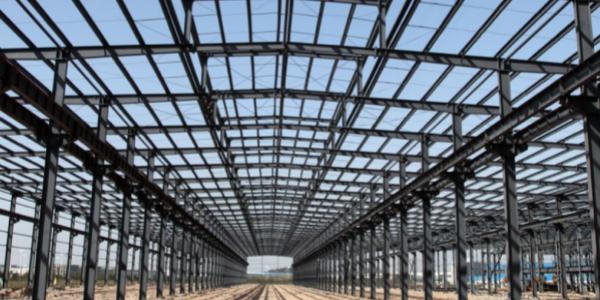
Common Types of Structural Steel Frames
1. Skeleton Steel Frame
Skeleton steel frames are the most common structural system for multi-story and high-rise buildings. In this system, the steel framework alone supports the entire building load, while exterior walls function primarily as enclosure elements rather than load-bearing components.
Key characteristics:
Loads are transferred from floors and roofs through beams and columns directly to the foundation
Beams and girders are connected using brackets, haunches, gusset plates, and shims
Spandrel beams are often installed around the perimeter to support masonry or curtain walls
Skeleton steel frames offer excellent flexibility in architectural design and are ideal for office buildings, hotels, and commercial towers.
2. Wall-Bearing Steel Frame
Wall-bearing frames are commonly used in low-rise or single-story structures, where both interior and exterior walls contribute to supporting floor and roof loads.
Key characteristics:
Structural loads are distributed through steel-supported walls
Frames are anchored using anchor bolts and end plates
Best suited for buildings with short spans and moderate load intensity
This system is often applied in warehouses, small industrial buildings, and low-rise commercial facilities where structural simplicity is prioritized.
3. Long-Span Steel Frame
Long-span steel frames are designed for buildings requiring large open spaces with minimal internal supports. These structures must accommodate heavy loads across wide distances.
Typical applications:
Sports arenas and stadiums
Theaters and auditoriums
Large industrial plants and logistics facilities
Common long-span structural systems include:
Steel Trusses
Highly rigid against bending, steel trusses can span significantly longer distances than single beams while maintaining structural efficiency.
Steel Girders
Thicker and stronger than standard beams, girders provide enhanced load-bearing capacity for wide spans.
Rigid Frames
Designed as continuous moment-resisting systems, rigid frames can withstand substantial shear forces and are suitable for heavy-duty industrial buildings.
Advantages of Structural Steel Framing
Structural steel framing is widely adopted due to the following benefits:
- High strength-to-weight ratio
- Excellent seismic and wind resistance
- Long service life with minimal maintenance
- Fast construction and precise fabrication
- Design flexibility for complex architectural layouts
Conclusion
Structural steel framing is a core construction method for high-rise buildings, industrial complexes, and large-span structures. Its strength, durability, and adaptability make it an ideal solution for projects that must withstand heavy loads, strong winds, and seismic activity. As construction demands continue to evolve, structural steel frames remain a fundamental component of modern engineering and architectural design.

 English
 Español


 Tel : +86-18565811709
 Email :
 News
News