Drill collars are essential heavy-wall tubular components in the Bottom Hole Assembly (BHA) of a drilling system. Designed to provide Weight on Bit (WOB), increase drill string stiffness, and maintain stable drilling conditions, they play a critical role in drilling efficiency and wellbore control.
For drilling contractors and oilfield equipment buyers, selecting the right drill collar depends on well conditions, drilling direction, downhole tools, and material requirements.
As a steel pipe manufacturer and project supplier, Union Steel Industry recognizes that drill collar performance depends not only on its design but also on material quality, dimensional accuracy, mechanical properties, and reliable manufacturing control.
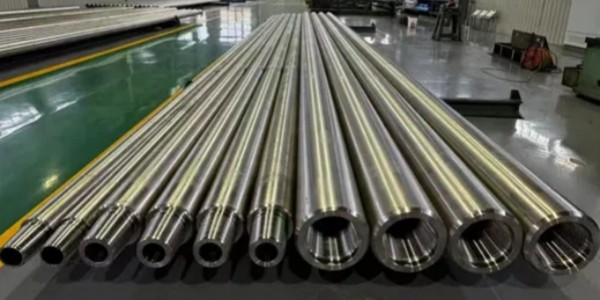
What Are the Main Types of Drill Collars?
Drill collars are commonly classified into four types: slick drill collars, spiral drill collars, non-magnetic drill collars, and pony drill collars. Each type is designed for specific drilling conditions and Bottom Hole Assembly configurations.
1. Slick Drill Collars
Slick drill collars feature a smooth, cylindrical outer surface without external grooves. Their solid, heavy-wall construction provides substantial weight per unit length and high rigidity.
Key advantages:
Provide effective Weight on Bit (WOB).
Offer excellent structural stiffness.
Feature a relatively simple design and cost-effective manufacturing.
Suitable for vertical wells and stable borehole conditions.
However, their larger contact area with the wellbore can increase torque, drag, and the risk of differential sticking, particularly in permeable formations.
2. Spiral Drill Collars
Spiral drill collars have helical grooves machined along their external surface. These grooves reduce contact between the collar and the wellbore wall, helping minimize differential sticking.
Key advantages:
Reduce wall contact and sticking risks.
Improve drilling fluid circulation around the collar.
Support drilling operations in deviated and directional wells.
Compared with slick drill collars, spiral designs generally have slightly less weight per unit length because material is removed during machining.
3. Non-Magnetic Drill Collars (NMDCs)
Non-magnetic drill collars are manufactured from specialized low-magnetic-permeability alloys, commonly austenitic stainless steel or nickel-based alloys.
Their primary purpose is to minimize magnetic interference with sensitive downhole instruments.
Key advantages:
Support accurate directional surveying.
Reduce magnetic interference with MWD and LWD equipment.
Help improve the reliability of downhole measurement data.
NMDCs are particularly important in directional and horizontal drilling operations. Their material selection, machining accuracy, and thread quality require specialized manufacturing and inspection procedures.
4. Pony Drill Collars
Pony drill collars are shorter versions of standard drill collars, available in different designs, including slick, spiral, and non-magnetic configurations.
They are mainly used to adjust the length and positioning of components within the Bottom Hole Assembly.
Key advantages:
Provide precise BHA length adjustments.
Help achieve the required spacing for downhole tools.
Offer flexibility in customized drilling configurations.
Pony collars are especially useful when standard-length drill collars cannot meet specific equipment or drilling design requirements.
How Do You Choose the Right Drill Collar?
Choosing the appropriate drill collar requires evaluating several technical and operational factors.
1. Drilling Conditions: Slick collars are generally suitable for stable vertical wells, while spiral collars are often preferred where differential sticking is a concern.
2. Downhole Measurement Requirements: Non-magnetic drill collars are necessary when MWD, LWD, or directional surveying equipment requires magnetic isolation.
3. BHA Configuration: Pony collars help achieve the required spacing and overall length of the Bottom Hole Assembly.
4. Material and Mechanical Properties: Buyers should consider material strength, toughness, corrosion resistance, and suitability for downhole operating conditions.
5. Manufacturing and Inspection Quality: Dimensional tolerances, straightness, surface condition, machining accuracy, and connection quality are important factors affecting service performance and operational reliability.
What Should Buyers Consider When Sourcing Drill Collar Materials?
For oilfield procurement teams and drilling equipment manufacturers, sourcing suitable steel materials is an important part of drill collar production.
Key purchasing considerations include:
Material specifications: Confirm the required steel grade, chemical composition, and mechanical properties.
Dimensions: Specify outside diameter, inside diameter, wall thickness, and length
Manufacturing requirements: Confirm machining, heat treatment, and applicable processing requirements.
Quality documentation: Request material test certificates and relevant inspection records.
Project requirements: Clarify technical drawings, applicable standards, inspection requirements, and delivery schedules.
At Union Steel Industry, we focus on steel pipe manufacturing and project-based supply, supporting customers with material selection, dimensional requirements, quality documentation, and coordinated delivery. Our experience in supplying steel pipes for industrial and energy projects helps us understand the importance of consistent material quality and dependable project execution.
Conclusion
Slick, spiral, non-magnetic, and pony drill collars serve different functions within the Bottom Hole Assembly. The right choice depends on drilling conditions, downhole measurement requirements, BHA configuration, and material performance.
For manufacturers and project buyers, reliable steel material sourcing and strict dimensional and quality control are equally important. Working with an experienced steel pipe supplier such as Union Steel Industry can help support consistent material quality and more efficient project procurement.
FAQ
1. What are the four main types of drill collars?
Slick, spiral, non-magnetic, and pony drill collars.
2. What is the difference between slick and spiral drill collars?
Slick collars have smooth surfaces, while spiral collars feature grooves that help reduce differential sticking.
3. Why are non-magnetic drill collars used?
They minimize magnetic interference with MWD, LWD, and directional surveying instruments.
4. What is the purpose of a pony drill collar?
It adjusts the length and spacing of components within the BHA.
5. What should buyers consider when sourcing drill collar materials?
Material grade, mechanical properties, dimensions, machining requirements, inspection, and quality documentation.

 English
 Español


 Tel : +86-18565811709
 Email :
 News