A drill collar size and weight chart helps drilling engineers, equipment buyers, and drilling contractors compare outside diameter (OD), inside diameter (ID), theoretical weight, standard length references, and connection options when selecting drill collars for a bottom hole assembly (BHA).
Drill collar selection depends on more than outside diameter alone. Bore size, required weight, connection compatibility, and BHA design all affect whether a particular drill collar is suitable for a drilling operation.
The following chart provides reference dimensions and theoretical weights for commonly specified drill collar sizes.
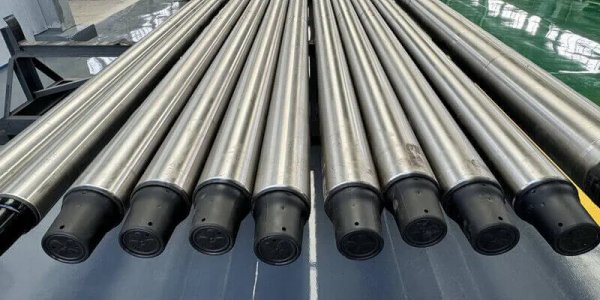
Drill Collar Dimensions and Theoretical Weight Chart
|
OD
|
OD (mm)
|
Bore / ID
|
ID (mm)
|
Theoretical Weight (lb/ft)
|
Theoretical Weight (kg/m)
|
Typical Length
|
Connection Reference
|
|
3-1/8 in
|
79.4
|
1-1/4 in
|
31.8
|
21.9
|
32.6
|
30 / 31 ft
|
NC23 / compatible connection
|
|
3-1/2 in
|
88.9
|
1-1/2 in
|
38.1
|
26.7
|
39.8
|
30 / 31 ft
|
NC26 / 2-3/8 IF reference
|
|
4-1/8 in
|
104.8
|
2 in
|
50.8
|
34.8
|
51.8
|
30 / 31 ft
|
NC31 / compatible IF
|
|
4-3/4 in
|
120.7
|
2-1/4 in
|
57.2
|
46.8
|
69.6
|
30 / 31 ft
|
NC38 / 3-1/2 IF reference
|
|
5 in
|
127.0
|
2-1/4 in
|
57.2
|
53.3
|
79.3
|
30 / 31 ft
|
NC38 / project connection
|
|
6 in
|
152.4
|
2-1/4 in
|
57.2
|
82.7
|
123.0
|
30 / 31 ft
|
NC44 / NC46 reference
|
|
6-1/4 in
|
158.8
|
2-1/4 in
|
57.2
|
90.8
|
135.1
|
30 / 31 ft
|
Match to BHA requirement
|
|
6-1/2 in
|
165.1
|
2-13/16 in
|
71.4
|
91.8
|
136.5
|
30 / 31 ft
|
NC46 / 4 IF / 4-1/2 REG reference
|
|
7 in
|
177.8
|
2-13/16 in
|
71.4
|
109.8
|
163.4
|
30 / 31 ft
|
NC50 / 4-1/2 IF reference
|
|
8 in
|
203.2
|
2-13/16 in
|
71.4
|
149.9
|
223.0
|
30 / 31 ft
|
6-5/8 REG reference
|
|
9 in
|
228.6
|
3 in
|
76.2
|
192.4
|
286.3
|
30 / 31 ft
|
7-5/8 REG reference
|
|
9-1/2 in
|
241.3
|
3 in
|
76.2
|
217.1
|
323.1
|
30 / 31 ft
|
7-5/8 REG reference
|
|
11 in
|
279.4
|
3 in
|
76.2
|
299.3
|
445.4
|
30 / 31 ft
|
Project / compatible API connection
|
Note: Dimensions and weights are theoretical reference values. Actual specifications, tolerances, connection details, and delivered weights should be confirmed against the applicable product specification and purchase order.
How to Read a Drill Collar Size Chart
Understanding the key parameters in a drill collar chart helps buyers compare products and prepare accurate technical specifications.
1. Outside Diameter (OD)
The outside diameter determines the drill collar's overall size and affects its clearance within the wellbore. The appropriate OD depends on the hole size, BHA configuration, and drilling requirements.
2. Inside Diameter (ID) and Bore Size
The inside diameter defines the internal bore of the drill collar. Bore size should be selected according to the required internal flow path and the specifications of the drilling assembly.
3. Theoretical Weight per Foot or Meter
The chart lists theoretical weight in both lb/ft and kg/m. These values provide a convenient basis for comparing drill collar sizes and estimating the total weight of a planned assembly.
For preliminary calculations:
Total theoretical weight = Weight per unit length × Total length
The result should be treated as an estimate. Actual delivered weight may vary with manufacturing tolerances and product configuration.
4. Typical Length
The chart uses 30 ft and 31 ft as typical length references. Actual supplied lengths should be confirmed when placing an order, particularly when the BHA design or transport requirements specify a particular length.
5. Connection Reference
Connection references such as NC, IF, and REG help identify potential drill string connection options. However, a reference listed beside a particular OD does not establish universal compatibility. Thread dimensions, connection type, tool-joint requirements, and the complete BHA design must be checked before ordering.
How to Select the Right Drill Collar Size
Choosing a suitable drill collar requires consideration of the complete drilling system rather than a single chart value.
Confirm the hole and BHA dimensions: Select an OD compatible with the wellbore and the planned bottom hole assembly.
Check the required weight: Compare theoretical weight per foot or meter to estimate the weight contribution of each collar.
Verify the bore size: Ensure the ID meets the drilling system's internal requirements.
Confirm connection compatibility: Specify the required connection standard and exact connection details rather than relying solely on a general reference.
Confirm length and quantity: Establish the required individual length, total assembly length, and number of collars.
Review the purchase specification: Confirm applicable standards, material requirements, inspection documentation, and dimensional tolerances with the supplier.
Why Accurate Drill Collar Specifications Matter
Accurate specifications help reduce procurement errors and improve coordination between drilling engineers, buyers, and manufacturers. A clear purchase specification should identify OD, ID, theoretical weight, required length, connection details, quantity, and any applicable material or inspection requirements.
Using a drill collar size and weight chart as an initial reference can streamline product comparison. Final selection should always be based on the approved drilling design and verified product specifications.
FAQ
1. What information does a drill collar size and weight chart provide?
It typically lists outside diameter, inside diameter, theoretical weight per foot or meter, typical length, and connection references.
2. What is the difference between drill collar OD and ID?
OD is the outside diameter of the drill collar, while ID is the diameter of its internal bore.
3. Are drill collar weights in the chart actual delivered weights?
No. The listed values are theoretical references. Actual weight may vary depending on manufacturing tolerances and product configuration.
4. Are drill collar connections interchangeable?
Not necessarily. Connection compatibility depends on the specified thread and connection design, so the details must be verified before ordering.
5. What length should be specified when ordering drill collars?
The chart uses 30 ft and 31 ft as typical references. The required length should be confirmed against the drilling program and purchase specification.

 English
 Español


 Tel : +86-18565811709
 Email :

 News