When planning a construction project, choosing between pre-engineered steel buildings (PEBs) and traditional structures has a direct impact on construction cost, project timeline, and long-term performance. This article provides a structured comparison of pre-engineered buildings and traditional construction methods, explaining why PEB buildings are increasingly adopted in industrial, commercial, and infrastructure projects.
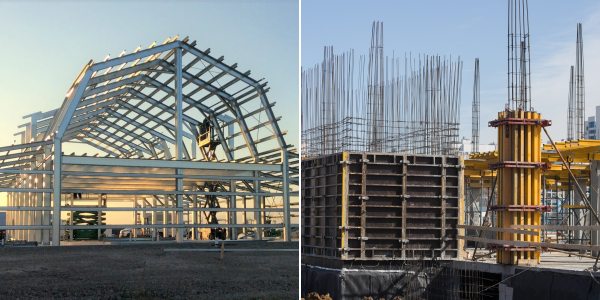
What Are Pre-Engineered Steel Buildings (PEBs)?
Pre-engineered steel buildings (PEBs) are steel structures that are designed, engineered, and fabricated off-site in a controlled manufacturing environment. All primary frames, secondary members, and connection components are produced in advance and delivered to the construction site for assembly.
Compared with traditional buildings, pre-engineered building structures minimize on-site fabrication, improve construction accuracy, and reduce material waste. This factory-based approach makes pre-engineered buildings more predictable in cost, schedule, and quality.
Pre-Engineered Steel Buildings vs Traditional Structures: Cost Efficiency Comparison
From a cost perspective, pre-engineered steel buildings are generally more economical than traditional structures.
A pre-engineered building structure uses optimized steel sections and standardized components, which significantly reduces raw material consumption and labor input. Since most fabrication work is completed in the factory, on-site labor costs are lower and construction errors are minimized.
In contrast, traditional construction relies heavily on on-site labor, extended schedules, and higher material waste, which often leads to increased overall project costs. For cost-sensitive projects, PEB buildings offer a clear financial advantage.
Speed of Construction: Why Pre-Engineered Steel Buildings Are Faster Than Traditional Construction
Construction speed is one of the most important advantages of pre-engineered steel buildings.
Because PEB structures are manufactured as ready-to-assemble components, on-site construction mainly involves bolting and erection rather than cutting, welding, and fitting. This significantly shortens the construction timeline compared to traditional buildings.
Additionally, pre-engineered building construction reduces delays caused by weather conditions and material shortages. As a result, projects using PEB buildings often reach operational readiness much earlier than those built with traditional methods.
Durability and Structural Strength of Pre-Engineered Steel Buildings
Pre-engineered steel buildings are designed to deliver long-term structural stability and durability.
PEB structures are engineered to resist extreme environmental conditions such as high wind loads, heavy snow, and seismic forces. Steel materials used in pre-engineered metal buildings are also resistant to fire, pests, and moisture-related damage.
Traditional structures, especially those using wood or masonry, may experience cracking, rotting, or termite damage over time. In comparison, pre-engineered buildings maintain structural integrity with minimal degradation, making them suitable for long-term industrial and commercial use.
Design Flexibility of Pre-Engineered Steel Buildings
Modern pre-engineered steel buildings offer a high level of design flexibility.
PEB buildings can be customized in terms of span, height, roof type, façade systems, ventilation, and internal layout. The modular nature of pre-engineered building structures also allows future expansion or modification without major structural disruption.
While extremely complex architectural designs may still favor traditional construction, most functional requirements for warehouses, factories, logistics centers, and commercial facilities can be efficiently achieved using pre-engineered buildings.
Environmental Impact of Pre-Engineered Steel Buildings
From a sustainability perspective, pre-engineered steel buildings offer clear environmental benefits compared to traditional structures.
The prefabrication process used in PEB buildings minimizes material waste and optimizes steel usage. In addition, steel is a fully recyclable material, reducing the environmental footprint of pre-engineered metal buildings over their lifecycle.
Traditional construction methods often generate more on-site waste and consume more natural resources, making pre-engineered buildings a more environmentally responsible option.
Maintenance and Lifecycle Cost of Pre-Engineered Steel Buildings
Pre-engineered buildings are designed for low maintenance and long service life.
High-quality steel components, protective coatings, and precise fabrication reduce the need for frequent repairs. Unlike traditional structures that may require ongoing maintenance due to cracking, corrosion, or material degradation, PEB buildings maintain performance with minimal upkeep.
Over the long term, this translates into lower lifecycle costs and improved operational reliability.
Pre-Engineered Steel Buildings vs Traditional Structures: Which Should You Choose?
Choosing between pre-engineered steel buildings and traditional structures depends on project priorities.
If speed, cost control, durability, and scalability are critical, pre-engineered buildings provide a clear advantage. Traditional construction may still be suitable for projects requiring highly customized architectural aesthetics.
For most industrial and commercial applications, PEB buildings deliver superior overall value.
Conclusion
Pre-engineered steel buildings offer a practical and efficient alternative to traditional construction by combining faster project delivery, lower costs, long-term durability, and sustainable performance.
Contact Union Steel to learn how pre-engineered steel buildings can enhance the performance and efficiency of your next construction project.
FAQ
1: Can pre-engineered steel buildings be expanded or modified later?
Yes, pre-engineered steel buildings use a modular design, allowing easy expansion or layout modifications without major structural changes.
2: How do pre-engineered buildings perform in extreme weather?
PEB structures are engineered to withstand high winds, heavy snow, and seismic loads, providing better resilience than many traditional buildings.
3: Are pre-engineered steel buildings environmentally friendly?
Yes, pre-engineered buildings reduce construction waste, use recyclable steel, and lower energy consumption, making them more sustainable than conventional construction.

 English
 Español


 Tel : +86-18565811709
 Email :
 News
News